Verification in Legal AI Is a Design Problem
Lawyers remain responsible. Legal AI should make its work easy to check before they sign.
"Open the pod bay doors please, HAL."
2001: A Space Odyssey shows the perils of handing over control to seemingly faultless machines.
A look at the growing list of AI sanctions across the country is enough to validate that concern. A recent case in Orange County resulted in not only sanctions but suspension of two immigration attorneys after courts found “multiple nonexistent cases, misattributed quotations and gross misrepresentations.” But it wasn’t just the use of AI, it was that the attorneys lied about its use.
The concern for both practitioners and the Legal AI industry is not only the dangers of improper use of AI, but the culture emerging around its use. Current solutions and guidance are still falling short.
It’s no surprise, then, that in daily conversations with legal practitioners around the country, many say they want to get started with AI but do not know where to begin.
For legal professionals just getting started with AI, here are six things to think about before implementation.
In a study released by Steven Shaw and Gideon Nave ‘Thinking — Fast, Slow, and Artificial’ (Wharton, 2026), it was found that 80% of people followed AI when it was wrong. The phenomenon was dubbed ‘cognitive surrender’ which is when a human adopts an AI-generated answer with minimal scrutiny. With authoritative answers and tone, people pattern match it as reasoning.
The effect worsened under time pressure, cognitive overload and with previous successful answers. The concerning part is that even when participants were wrong, those who used AI felt more confident in their answer.
With cognitive surrender worsening under conditions which closely match litigation, understanding why these failures occur is critical to safely implementing AI in legal practices.
Speak to us to learn more.
Temperature is a setting on AI models that determines the degree of diversity and creativity in answers.
General AI, high temperature: General models like Claude and ChatGPT by default are set at a higher temperature. That makes them great for the kinds of tasks that benefit from creativity and breadth: brainstorming arguments, exploring alternative framing, building templates, and accelerating learning. The trade‑off is a higher risk of hallucinations.
Purpose‑built legal AI, tuned temperature: Purpose‑built legal platforms (like Mary Technology) fine tune temperature for specific tasks. Instead of trying to be creative across any topic, outputs are prescriptive and traceable rather than speculative. This makes purpose built tools better suited to tasks where accuracy, transparency, and repeatability are critical, such as reviewing discovery material or analyzing case files.
For legal professionals, the key is matching the temperature to the activity: use higher‑temperature tools for ideation and learning, and purpose‑built tools for factual accuracy, discovery and legal workflows where ethical obligations and verification requirements are strict.
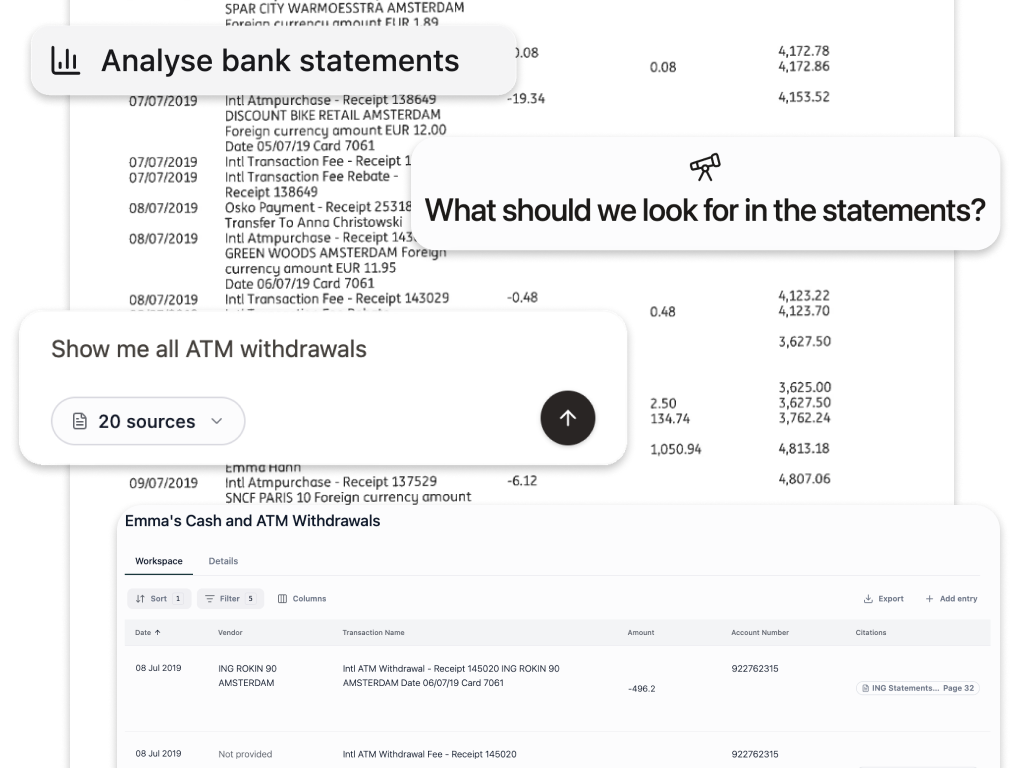
One of the limitations across many AI tools is that users can’t see what the system reviewed, ignored, summarized or prioritized. When generating an answer, many tools cannot clearly identify what documents were reviewed vs not.
Providers should be demonstrating exactly what was done under the hood in arriving at an answer to facilitate deliberate review and interrupt cognitive surrender. Negative space can look like -
In Shaw and Nave’s study, ‘Thinking — Fast, Slow, and Artificial’ (Wharton, 2026), intelligence was not a predictor of whether or not someone would adopt an incorrect AI answer. That means it is not enough to tell teams, especially junior attorneys to simply “use their judgement” - especially as they are building it.
Rather than left to instinct, good AI use requires training and support by technology.
Verification workflows that introduce “productive friction” - slowing users down at critical points - for review and deliberate application of judgement are essential for quality output. They also build confidence.
Firms should build a workflow, not just buy a tool. Firms that buy a tool rarely realise the benefits promised by AI. Often, the purchase creates incremental efficiency rather than a genuinely improved way of working. It is also common for the highest effort in an organization to be applied to the procurement of something new, rather than integrating it into work.
Make sure in choosing a vendor that you are working with someone who can meaningfully partner with you to implement. The real gains come from process design, and adoption, nor from procurement alone.
Across the United States, legal professionals must consider duties of competence, communication, disclosure and candour when adopting AI tools. It is your professional obligation to understand the fail points and inherent weaknesses of any tool implemented in your practice. Informed client consent also requires more than just a disclosure.
AI adoption in legal practice should start with those obligations, not be retrofitted to them later.
For firms at the earliest stage of adoption, the most effective starting point is not broad experimentation, it is choosing the right use cases, setting clear verification steps and training teams to use AI with friction and judgement.
If you’d like to speak to our founding and Exec team in the US about any of these topics, book a chat here.