Verification in Legal AI Is a Design Problem
Lawyers remain responsible. Legal AI should make its work easy to check before they sign.
By Harry Raworth, Co-Founder, Mary Technology.
Legal AI is making research, drafting and summarisation faster and cheaper. In disputes, that does not make the underlying record any easier to build.
A brief can read well and still rely on the wrong date. It can miss the attachment everyone assumed was in the production. It can repeat a witness account the contemporaneous documents contradict. A good lawyer catches the obviously wrong answer. The one that scares me looks right and has a hole in it.
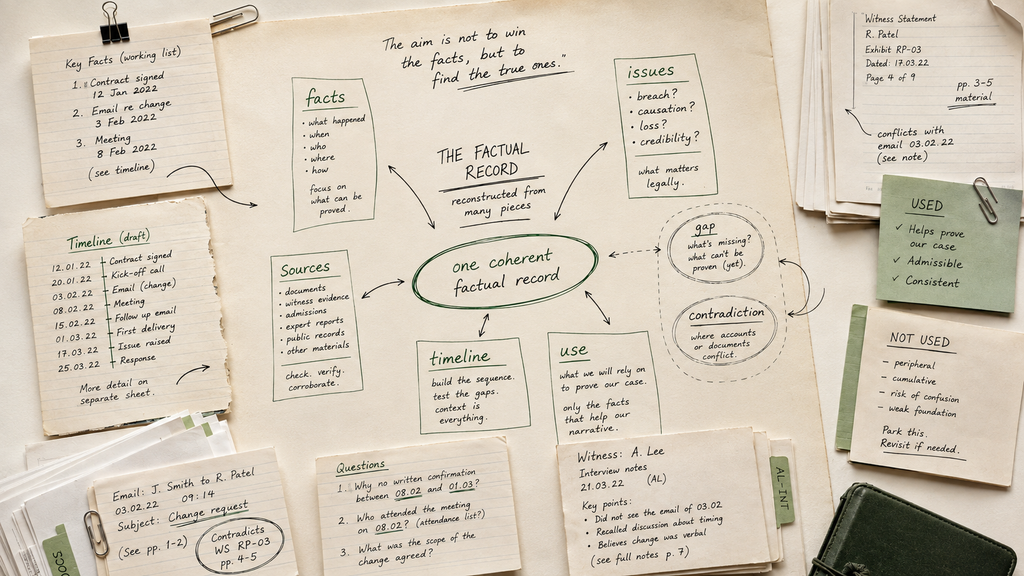
The document that was reviewed but never used. The gap between two important events. Financial records that do not match the disclosure. The attachment referred to but never produced. The issue that stays open because nothing in the material resolves it.
Those things can matter as much as the facts that made it into the answer.
Legal knowledge and drafting patterns can be reused across matters. The evidentiary record is specific to this one. It develops over time and is often incomplete or contested.
As AI takes on more of the work, that record becomes more important. A model can draft, compare, summarise and suggest. It still needs to know what supports a proposition, what conflicts with it, what remains unresolved and where the evidence came from.
The lawyer still has to check it.
Legora’s acquisition of Wexler is one sign that the market sees the value of this factual foundation. Wexler built serious capability around reconstructing complex disputes, and Legora chose to bring that capability into its broader platform.
For firms, the important thing is that the factual work already done on a matter does not have to be rebuilt when the work moves into another tool.
A dispute may move through document management, eDiscovery, email, spreadsheets, drafting software and more than one AI tool. It also moves between associates, partners, litigation support, clients, counsel and experts.
If every tool rebuilds its own version of what happened, the firm repeats work it has already done and ends up reconciling different versions of the same matter.
Better retrieval does not remove that problem. A model might eventually be able to reread every document in a matter almost instantly. The documents alone still do not tell it what the team previously accepted, rejected, left unresolved or approved. That review history is part of the record too.
The record changes as the matter changes.
New documents arrive. Communications surface. Witness accounts add detail or create new conflicts. Expert material changes the picture. Some matters settle quickly. Others run for years.
Mary is built around maintaining that record as the matter develops.
Mary starts with the whole matter before the first question. It keeps exact sources, document coverage, contradictions, gaps, unused material and review state visible. Proposed changes to the reviewed record stay pending until an authorised person at the firm approves them.
None of this decides what the evidence means, which witness to believe or what position to take. That remains the lawyer’s job.
The same record can support different work as the dispute develops: understanding the matter, testing what the evidence supports, preparing witnesses, negotiating, drafting or getting ready for a hearing.
As firms use more tools, they will expect the factual work already done on a matter to carry forward with them.
Firms will use more AI, not less. The models will get better. The matter will keep changing.
The factual record has to carry forward.
