Verification in Legal AI Is a Design Problem
Lawyers remain responsible. Legal AI should make its work easy to check before they sign.
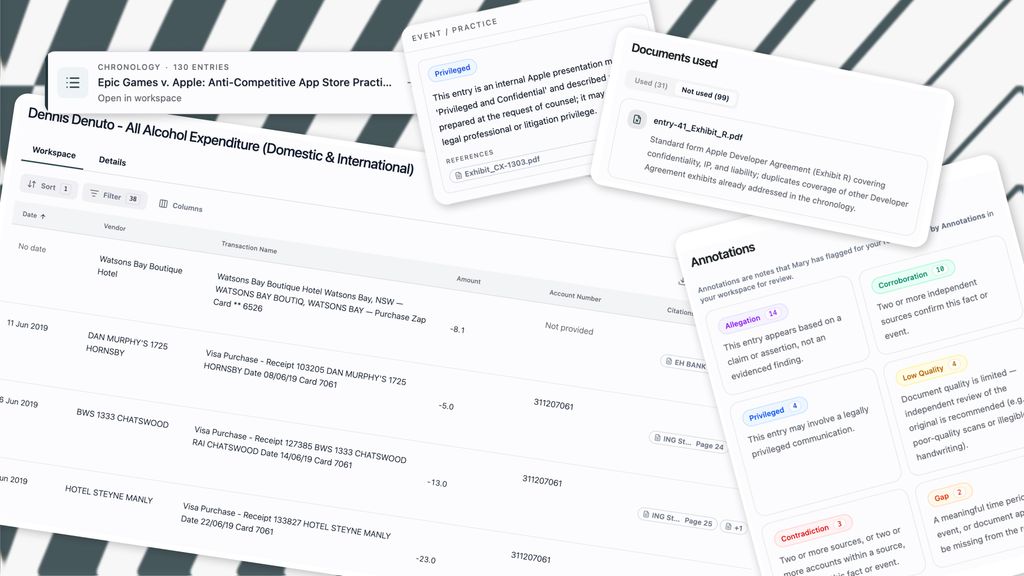
Mary now supports three additional ways to use the factual record of a matter: custom chronologies, bank statement analysis and template-based drafting.
Each capability is designed to keep the resulting work connected to the documents from which it was produced, so lawyers can inspect the evidence before using it.
A single timeline is not useful for every question in a matter. A chronology for financial disclosure may need different dates and facts from one prepared for a witness or a particular allegation.
Custom Chronologies let a lawyer describe the parties, period and issues they want to examine. Mary builds a scoped timeline from the matter record, with entries linked to the relevant source document and page.
The chronology can be refined as the matter develops and new documents are added.
The feature also helps the team examine periods or expected material that do not appear in the documents. Examples include missing bank statements, a break in communications or an attachment referred to in correspondence but absent from the file.
The system can point the lawyer toward those gaps. The lawyer decides whether the absence matters and what should follow.
Bank statement review often requires the team to identify repeated merchants, transfers between accounts, cash withdrawals and transactions that do not fit the disclosed financial picture.
Lawyers can upload the statements and ask defined questions such as “show me the ATM withdrawals” or “identify transfers to this account”. Mary structures the relevant transactions and keeps each result linked to the statement and page on which it appears.
The resulting analysis is a starting point for legal or forensic review. It does not replace the lawyer’s assessment of what the transaction means.
Firms often need to turn the same factual structure into repeated work product, including memos, letters and forms.
Template-Based Drafting uses the matter record to populate a firm’s chosen structure. Factual claims in the draft remain connected to the underlying evidence so the reviewer can inspect them before approval.
The lawyer remains responsible for the form, legal analysis and final work product.
These capabilities use the same factual record rather than asking the model to reconstruct the matter for each new task.
That means a reviewed correction can carry into later chronologies, analysis and drafts while the source remains available to the team.
Firms can book a demonstration to see the three capabilities on a representative matter.